


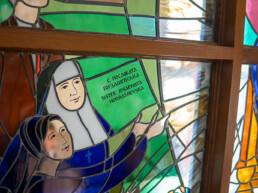

From a modest classroom in 1905, Immaculate Heart of Mary School has grown into one of Winnipeg’s most treasured Ukrainian Catholic institutions. For over 120 years, faith, academic excellence, Ukrainian culture, and community have remained its four enduring pillars.
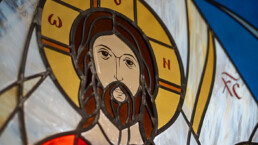
1904
A School Takes Root: The Ridna Shkola
Father Matthew Hura, OSBM, recognized early on that building a church was only part of his mission. With hundreds of Ukrainian immigrant children in Winnipeg’s north end unable to speak English and without access to formal education, he established a Ridna Shkola (Ukrainian reading school) in 1904. This informal school gave children their first structured learning experience in their mother tongue. It was this initiative that led Father Hura to reach out to the Sisters Servants of Mary Immaculate, directly setting in motion the founding of North America’s first Ukrainian Catholic grade school.
1905
School Founded at Edinger Hall
On August 28, 1905, approximately 50 children gathered at Edinger Hall, the National Home for Ukrainian Canadians, at the corner of Selkirk and McGregor. Sisters Athanasia Melnyk and Alexia Chykalo, who had arrived in Winnipeg on June 16, opened the first Ukrainian Catholic grade school in North America. Most students came from families who had recently immigrated from Ukraine and could not yet speak English. Teaching in a space never designed as a classroom, the two Sisters nevertheless created something that would endure, and grow, for over a century.
1906-1907
The School Moves to St. Nicholas Church
After a year at Edinger Hall, the Sisters relocated the school to the basement of the newly constructed St. Nicholas Church at Stella and McGregor Avenue, the first Ukrainian Catholic Church in Winnipeg. Enrolment grew to approximately 160 students, and a third teacher, Sr. Nicholas Petrushkevich, joined the staff. The Basilian Fathers assisted with catechism and Ukrainian instruction, providing essential financial and moral support. In 1907, they formally transferred complete control of the school to the Sisters Servants of Mary Immaculate, who would carry it forward for generations to come.
1911
St. Nicholas School Opens
Archbishop Langevin secured funding from the Canadian Episcopate to build a proper school for Winnipeg’s Ukrainian children. On October 22, 1911, Fr. A. Filipow, OSBM, blessed the first purpose-built St. Nicholas School at Flora and McKenzie, a two-storey brick building with five classrooms, a chapel, and a Sisters’ residence. Four hundred students enrolled on opening. Two days later, on October 24, the Sisters and children moved into their new home, bringing to an end years of teaching in the damp, flood-prone basement of St. Nicholas Church.
1920s
A Community Rallies: Enrolment Surges
The opening of St. Nicholas School sparked immediate enthusiasm across Winnipeg’s Ukrainian community. By 1914, enrolment had reached 240 students, and by 1920 it had climbed to approximately 400. Many students were turned away at the door. Despite this growth, the school faced serious financial hardship through World War I and the Depression, when many families could barely afford the 50-cent monthly tuition. The Sisters responded with extraordinary resourcefulness, organizing concerts, bazaars, and teas while often rationing their own food and heat to keep the school open.
1920s
A Community Rallies: Enrolment Surges
The opening of St. Nicholas School sparked immediate enthusiasm across Winnipeg’s Ukrainian community. By 1914, enrolment had reached 240 students, and by 1920 it had climbed to approximately 400. Many students were turned away at the door. Despite this growth, the school faced serious financial hardship through World War I and the Depression, when many families could barely afford the 50-cent monthly tuition. The Sisters responded with extraordinary resourcefulness, organizing concerts, bazaars, and teas while often rationing their own food and heat to keep the school open.
1931
The Benefit School Committee Forms
Amid the hardships of the Great Depression, a group of dedicated parents led by Dan Yuskewich formed the Benefit School Committee in 1931 to help share the financial burden that the Sisters could no longer carry alone. Meeting every two weeks, the committee organized concerts, bazaars, fashion shows, and teas. Members also hand-sewed priests’ vestments and contributed to the upkeep of St. Nicholas Church. Born out of necessity during one of the school’s most difficult chapters, this committee established the tradition of parent and community involvement that remains central to IHMS life to this day.
1955-1957
Growth, Change, and the Academy Years
By its 50th anniversary in 1955, St. Nicholas School served students from Kindergarten through Grade 12. As the aging building struggled to keep pace, Provincial Superior Bernadette Warick, SSMI proposed building a nursing home rather than a new school, a decision that led to the founding of Holy Family Nursing Home. The dream of a secondary school wasn’t abandoned: on May 26, 1957, the Immaculate Heart of Mary Academy was officially opened at the Sisters’ residence at 131 Aberdeen Avenue, with classes beginning September 1. Thirty girls enrolled in Grades 9 and 10. It was also the first time the Immaculate Heart of Mary name was used.
1961–1963
A New School for a New Era
In 1961, former students Walter Paschak and Walter Sahan co-chaired a building committee to raise funds for a new school at 650 Flora Avenue. Construction was led by contractor Steve Zulak and architect Alex Nitchuk, with one distinctive touch: the entire school was carpeted, a novelty that drew attention across the country. On April 28, 1963, over 2,000 people gathered for the opening, blessed by Archbishop Maxim Hermaniuk and attended by Premier Duff Roblin. Artist Steve Repa designed the Blessed Mother sculpture on the school’s exterior wall, chosen with Metropolitan Hermaniuk’s personal guidance.
1963–1967
A New Name, A New Chapter
With the opening of the new building in 1963, the school formally shed the St. Nicholas name it had carried for over fifty years. As the new Ukrainian Catholic Archeparchy school for Winnipeg, a fresh identity was needed, one not tied to a single parish. The Immaculate Heart of Mary name, first used at the 1957 Academy, was the natural choice. Two years after opening, IHMS settled permanently into its Kindergarten to Grade 8 format. Around 1967, the original St. Nicholas School building at Flora and McKenzie was finally torn down, closing a chapter that had begun in 1911.
1995
A New Kind of Leader
On December 18, 1995, Rod Picklyk was appointed principal of Immaculate Heart of Mary School, the first lay person to hold the role in the school’s 90-year history. It marked a quiet but significant turning point: the daily leadership of the school, long carried by the Sisters Servants of Mary Immaculate, was now shared with the broader community it served. The mission remained unchanged, but the model had evolved. Sr. Anne Pidskalny, SSMI, continued as Director, ensuring the founding charism of the Sisters remained at the centre of everything the school does.
2005
The 100th Anniversary and Beyond
On October 7–9, 2005, alumni, staff, and friends gathered for a three-day centennial celebration which included a wine and cheese, a banquet, a special Divine Liturgy at St. Nicholas Church, and a family barbecue. During the festivities, a time capsule sealed at the June 1962 cornerstone blessing was opened, its contents a vivid window into the school’s mid-century life. In a defining moment for the school’s future, IHMS also announced it had purchased land in the Old Kildonan area of Winnipeg, the first step toward a brand new building that would carry the Spirit forward into the school’s second century.
2005-2015
A Dream Deferred
In 2005, IHMS announced an ambitious plan: purchase land in the Old Kildonan area of Winnipeg and build a state-of-the-art facility for the school’s second century. In 2008, land on Ferrier Street was acquired and plans were drawn up. Over the following years, the Sisters Servants of Mary Immaculate faced a competing priority of equal importance, a major expansion of Holy Family Home, the personal care facility they had operated since 1957. The $66.7-million nursing home project ultimately took precedence. In June 2015, the new school fundraising was paused indefinitely, with a portion of the funds redirected to upgrade IHMS’s existing facilities. The Ferrier Street property remains part of the school’s story to this day.
2017
Renewed Inside and Out
The summer of 2017 brought the most significant physical renewal of IHMS since 1963. Outside, the playground was completely transformed: a brand new play structure, newly asphalted surface with stencilled games, a soccer field, a basketball court, and new fencing. Inside, most classrooms and offices received new carpeting, with select areas receiving new flooring. The old gym and music teacher’s office became a dedicated Resource Room; the former Resource Room was revitalized as a Music Classroom — a return to its original intended purpose. The Art Room received a full overhaul. Funding came in part from the Michael Bzdel Endowment Fund and the Sisters Servants of Mary Immaculate, with special acknowledgment to custodians Ivan Fil and Rostyslav Trokhanovskyy for their extraordinary efforts.
2020-2022
Learning Through a Pandemic
On March 23, 2020, Manitoba suspended all in-school classes in response to COVID-19 and IHMS, like every school in the province, pivoted overnight to full remote learning for the remainder of the school year. When September arrived, students and staff navigated a constantly shifting hybrid landscape: some weeks fully in class, others entirely at home, and many in between — half-classes, staggered schedules, and rotating cohorts. Through it all, the IHMS community held together, leaning on the same spirit of resilience that had carried the school through the Depression, two world wars, and a flooded basement a century before.
2022-Present
Welcoming Ukraine's Children
When Russia’s full-scale invasion of Ukraine began on February 24, 2022, IHMS responded with the same instinct that has defined it since 1905, open the doors. More than 70 families and over 100 students from Ukraine found their way to the school that had kept Ukrainian language, faith, and culture alive in Winnipeg for over a century. To support them, IHMS offered reduced tuition and fees, school uniforms, school supplies, and complimentary before and after school child care. Classrooms filled to capacity. The mission the Sisters had carried since 1905, to educate and welcome Ukrainian children, had never felt more alive.
2019-2022
Building a Foundation for Technology
In October 2019, IHMS took its first major step toward modernizing its technology program with the acquisition of six iPads. The remainder of the first cart arrived in September 2020, followed by a second cart in April 2021. That same year, the school’s server, network, and cabling infrastructure was overhauled in phases over spring break and summer, and the computer lab was fully refreshed. In 2022, every classroom received an upgraded iMac for shared teacher and student use. What began as a single cart of six devices had grown into a school-wide foundation for 21st-century learning.
Today and looking ahead
The Spirit is strong
Immaculate Heart of Mary School enters its next chapter with optimism, creativity, and the same Spirit that has sustained it for over 120 years. The athletics program continues to thrive, with teams winning banners year after year. A Technology Club has introduced students to coding, drone piloting, and Sphero robotics — and in 2026, a Grade 4 class won a contest that brought the school’s first 3D printer through the door. The library is undergoing a full digitization initiative: all materials are being catalogued digitally, and within the coming year families will be able to search the collection from home and access a complete digital checkout system. New clubs and initiatives continue to grow, shaped by the remarkable talents of IHMS’s dedicated teachers and staff. With a strong community, a commitment to innovation, and the mission of the Sisters Servants of Mary Immaculate at its heart, the school looks confidently ahead.
Pioneers at IHMS
Lorem ipsum dolor sit amet

Sr. Athanasia Melnyk, SSMI
Sr. Athanasia (Theodosia) Melnyk, SSMI was among the earliest missionaries sent by the Sisters Servants of Mary Immaculate to Canada, and the first to help establish a Ukrainian Catholic school in North America. She arrived in Winnipeg on June 16, 1905, alongside Sr. Alexia Chykalo, and that August opened the first Ukrainian Catholic grade school on the continent at Edinger Hall. She had herself immigrated from Ukraine as a young woman before entering religious life — making her mission to Winnipeg both a personal and spiritual homecoming to her people. Her memoirs, preserved by the SSMI, remain a powerful testimony to her devotion.
Sr. Alexia Chykalo, SSMI
Sr. Alexia Chykalo, SSMI arrived in Winnipeg on June 16, 1905 (the same day as Sr. Athanasia Melnyk) having journeyed from Lviv as a member of the Sisters Servants of Mary Immaculate. Together, the two Sisters prepared through the summer and opened the school at Edinger Hall on August 28, 1905, welcoming approximately 50 children, most of them Ukrainian immigrants who could not yet speak English. Sr. Alexia shared equally in every hardship and triumph of those founding years — teaching in difficult conditions while laying the groundwork for a school that would serve generations of Winnipeg families.
Rev. Fr. Matthew Hura, OSBM
Father Matthew Hura, OSBM, born in Ukraine in 1873 and ordained in 1897, arrived in Winnipeg in November 1903 as one of the city’s first Basilian missionaries. He built St. Nicholas Church (the first Ukrainian Catholic church in Winnipeg) and established a Ridna Shkola in 1904 to educate children who could not yet speak English. He then reached out to the Sisters Servants of Mary Immaculate to found a proper school, and also established the Prosvita Reading Society and St. Nicholas Brotherhood, making him the architect of Ukrainian Catholic community life in Winnipeg.
Archbishop Adélard Langevin
Archbishop Adélard Langevin served as Archbishop of St. Boniface from 1895 until his death on June 15, 1915. A tireless advocate for Ukrainian Catholic immigrants, he lobbied authorities across Canada and Europe to secure priests and teachers for Winnipeg’s growing community, even writing personally to Emperor Francis Joseph of Austria on behalf of Ukrainian children. He personally funded the construction of St. Nicholas Church and secured the Canadian Episcopate funding that built St. Nicholas School in 1911. He is remembered as the foremost non-Ukrainian champion of IHMS’s founding mission.
Walter Paschak & Walter Sahan
Walter Paschak and Walter Sahan (both former St. Nicholas School students) co-chaired the building committee that raised funds for the 1963 Immaculate Heart of Mary School. The campaign grew from a single $100 pledge at a choir party into a full community fundraising operation that made a $200,000 building possible without government support. Sahan drove key decisions on design and ran the Fidelity Club’s Thursday bingo nights for decades to sustain the school financially. In November 1963, Paschak received the Knight Commander of St. Sylvester, the first Ukrainian in North America to receive such a papal distinction.
Archbishop Maxim Hermaniuk, CSSR
Metropolitan Archbishop Maxim Hermaniuk, CSsR, was the most important church figure in IHMS’s modern history. He approved the decision to build Holy Family Nursing Home in 1955, blessing the Sisters’ difficult choice over a new school. He presided over the April 28, 1963 opening of Immaculate Heart of Mary School and personally guided the selection of Steve Repa’s Blessed Mother sculpture for the school’s exterior wall. Elevated in 1957 as Canada’s first Ukrainian Catholic Metropolitan Archbishop, he remained a champion of IHMS until his death on May 3, 1996, passing away while praying the rosary.
Sr. Anne Pidskalny, SSMI
Sr. Anne Pidskalny, SSMI, arrived at Immaculate Heart of Mary School in September 1979 and has been one of its most enduring and defining figures. During her long tenure as Teacher and SSMI Director, she served as the vital link between the school and the Sisters Servants of Mary Immaculate, attending Board meetings, consulting on all matters of faith and mission, and reporting to the Provincial Superior. Her most memorable moment came in 1984, when she co-ordinated a province-wide art contest for the Pope’s Winnipeg visit, and watched two IHMS children present roses to the Holy Father. She co-chaired the 2005 centennial celebration alongside Principal Rod Picklyk.
Rod Picklyk
Rod Picklyk became principal of Immaculate Heart of Mary School on December 18, 1995, the first lay person to hold the role in the school’s 90-year history. He took on a school with deep roots but real financial pressures, navigating the challenges of partial government funding for independent Catholic education. His tenure has been defined by academic excellence, a renewed commitment to Ukrainian Catholic identity, and a close working relationship with the Sisters Servants of Mary Immaculate to ensure the founding mission endures. He co-chaired the 2005 centennial celebration and continues to lead IHMS today.